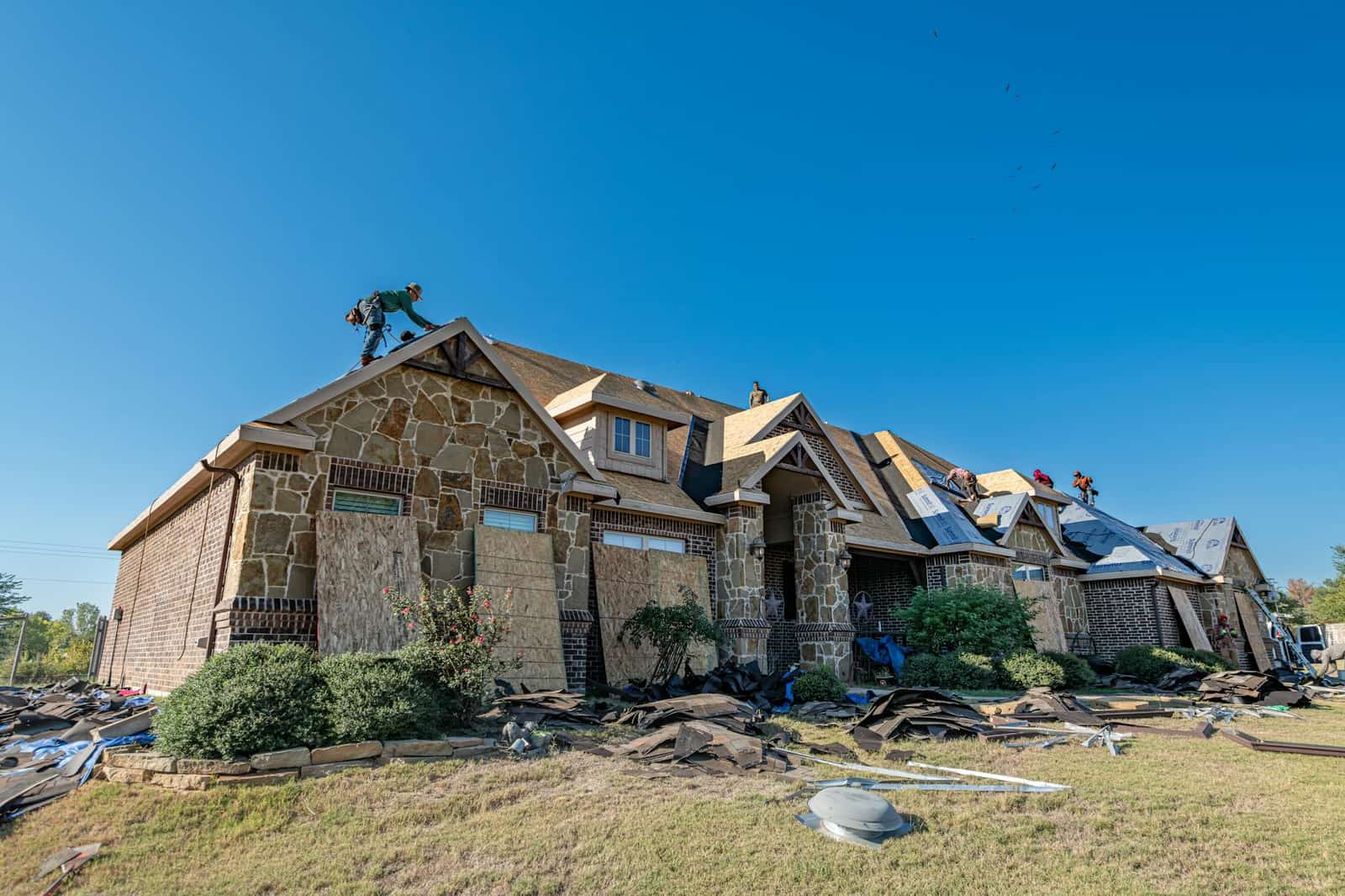
Dallas, TX
Roof Repair in Dallas, TX: Get a Local Repair Quote
Targeted repairs for leaks, missing shingles, flashing failure, and minor storm damage, with fast turnaround from local contractors in our network.
Tell us what's wrong and we'll line up Dallas repair specialists who handle your exact scope.
Roof repair in Dallas, TX is a local-code, local-climate, and local-labor-market decision. We connect Dallas homeowners to a roofer in our network who handles your scope and timeline, by phone.
Roof repair in Dallas is a hail-claim, wind-loss, and timing decision
A Dallas-Fort Worth roof repair almost always traces back to a documented weather event. The metroplex sits at the center of the highest-frequency hail corridor in the United States per the NOAA Storm Events Database, so most repair calls in Plano, Frisco, McKinney, Carrollton, Richardson, Allen, and Highland Park are post-storm scopes routed through carrier claims rather than out-of-pocket patches. Knowing what's repair-worthy vs. what's pushing toward a full replacement, and what the carrier's matching provision actually covers, is the value the right contractor brings to the inspection.
If you have visible damage from any 2024–2026 hail or wind event, an active leak, or shingle granule loss after the latest storm, talk to screened DFW repair pros — most network contractors offer a written inspection and a no-obligation scope.
What actually drives DFW roof repairs
Four failure modes account for the bulk of repair work across the metroplex:
- Hail-impact damage. This is the dominant repair driver. The DFW metroplex records more 1"+ hail events per year than any other major U.S. metro, with cells especially active across Collin, Denton, Dallas, and northern Tarrant counties. Most repair calls in March–June trace to a recent storm event. Damage frequently goes undiagnosed when an adjuster walks the roof without a Haag-cert inspector present.
- Wind uplift and ridge-cap loss. The thunderstorm complexes that generate hail produce 60–80 mph gusts and occasional 90+ mph microbursts. Ridge caps, hip caps, and the first three courses below the eave are the textbook uplift failure points. Six-nail patterns survive these; four-nail "builder grade" installs from the 2000s do not.
- Tornado-track damage. Spring tornado season layers severe straight-line winds plus occasional EF-0 to EF-2 tornado tracks onto the same roof envelope. EF-0 and EF-1 damage routinely produces repairable partial-slope or full-slope scope; stronger events push into replacement territory.
- Flashing degradation. Step flashing along brick chimneys, skylights, and roof-to-wall transitions is the second-largest leak source on DFW homes 8+ years old. Hot summers thermally cycle the metal harder than cooler climates, and the seal breaks before shingles themselves fail.
The right repair scope depends on which combination is at play. A single hail event can produce damage on multiple slopes that an adjuster's first walk misses entirely.
When to repair vs. when to replace in Dallas
For most metroplex roofs, the decision turns on damage extent and policy specifics:
- Roof under 10 years old, single-slope hail or wind damage, intact shingles elsewhere: targeted repair plus a Haag-cert inspection of the rest of the roof. A claim that opens on a young roof typically gets paid as a repair scope when damage is isolated.
- Roof 10–15 years old, multi-slope damage post-2024 hail season: this is the "matching provision" zone. When matching shingles are no longer manufactured or unavailable in the same lot dye, Texas case law and most policy language support full-slope or full-roof replacement so the resulting roof presents as a single uniform field. Adjusters often write partial-slope scope on a roof that qualifies under matching; the supplement workflow is paperwork, not litigation.
- Roof past 15 years with significant hail history, multiple leak points, or visible granule loss: replacement is the better economic call. See our Dallas roof replacement page and our is it cheaper to repair or replace a roof guide for the full decision framework.
- Any roof with Class 4 impact-rated shingles and a documented hail-resistance discount: the carrier program details matter. Some discounts only apply if the roof remains documented Class 4 after the repair, which means matching the original product.
A good DFW repair contractor inspects the full roof field, documents damage with date-stamped photos, writes a complete cause-of-loss scope, and walks you through the supplement path if the adjuster's first scope undercounts.
Dallas-specific repair scope items
Five items separate a quality DFW repair from a generic patch:
- Class 4 product matching. Many Texas carriers offer hail-deductible discounts or premium credits for documented Class 4 (UL 2218) installations per the TDI-published carrier credit list. On repair scope, matching the original Class 4 product preserves the discount; downgrading often voids it.
- Six-nail pattern with ring-shank deck nailing. The manufacturer's high-wind pattern is the only one that survives DFW microburst events without uplift. Confirm this in writing.
- Flashing replacement, not bend-back. Step flashing along chimneys, skylights, and roof-to-wall transitions should be replaced with new metal, not bent back. The seal is gone the moment original flashing flexes.
- Haag-cert inspection for any storm-claim work. Haag-certified inspectors are the recognized standard for cause-of-loss reports on Texas roof claims, and the path from an undercounted adjuster scope to a complete supplement runs through a Haag-cert report.
- Permits. The City of Dallas requires a residential repair permit for repairs above a defined scope. Plano, Frisco, Allen, McKinney, Richardson, Carrollton, Garland, Mesquite, Irving, and the surrounding metroplex cities enforce parallel rules. No legitimate DFW roofer skips this.
Neighborhoods where repair calls cluster
Demand patterns vary across the metroplex:
- Highland Park, University Park, and Lakewood — older asphalt and tile roofs on mid-century homes. Repair scopes routinely include slate or specialty tile reset work alongside shingle repairs.
- Plano, Frisco, McKinney, and Allen — 1995–2015 asphalt across master-planned communities, heavy hail exposure. Most repair calls post-storm with carrier claim documentation.
- Carrollton, Richardson, and North Dallas — 1970s–2000s housing stock at the central DFW hail-density peak. Class 4 product matching dominates the scope conversation here.
- Arlington, Grand Prairie, and Mansfield — Tarrant County demand with strong wind exposure on the southwestern edge. Six-nail pattern non-negotiable.
- Rockwall, Wylie, and Sachse — younger roofs across rapidly developed neighborhoods. Watch for builder-grade three-tab shingles that the carrier may total rather than repair.
Insurance and repair in Texas
Texas is among the most active roof-claim states in the country. Tex. Ins. Code Chapter 542A governs weather-related claim procedures and most major carriers maintain Texas-specific endorsements for hail and wind. Notice windows are typically 30–60 days from the storm date.
The matching provision is the single most consequential clause for DFW repair work. When shingles in the same color and run are no longer available, the policy and Texas case law support full-roof replacement so the field reads as one uniform install. Document matching-unavailability statements from your contractor and submit them with the supplement.
Texas law prohibits a contractor from paying or waiving your insurance deductible. A roofer offering to eat the deductible is operating outside the statute; walk away.
See our guides on does insurance cover roof replacement, the insurance adjuster meeting checklist, and ACV vs RCV settlement math for the full sequence.
What to expect from a network match
Every DFW contractor in our network carries an active Texas roofing credential where applicable, general liability insurance, and a clean background check before any homeowner lead reaches them. We ask network partners to re-confirm annually. Match flow: tell us about your project, we route the lead to up to three DFW-area pros who specialize in the repair type and damage profile you have, and you collect written scopes on the same damage before deciding. See our Dallas city hub for the full local match context, our Dallas roof replacement page if your damage is pushing toward full replacement, and our editorial policy for sourcing standards.
Neighborhoods we serve
- Highland Park
- Plano
- Frisco
- Uptown
- Lakewood
- Oak Cliff
- Arlington
- Fort Worth
Other services in Dallas
Roof Replacement in Dallas
Roof Replacement from local Dallas pros.
Storm Damage in Dallas
Storm Damage from local Dallas pros.
Flat Roofing in Dallas
Flat Roofing from local Dallas pros.
Metal Roofing in Dallas
Metal Roofing from local Dallas pros.
Roof Inspection in Dallas
Roof Inspection from local Dallas pros.
Roof Repair in nearby cities
Related guides and tools
Talk to local roof repair pros in Dallas
Talk to a Dallas roof repair pro who handles full and partial replacements.
Under a minute. One local pro, not 12.
Lead-routing service. Calls may be recorded.